When AI rides a habit laddering wave — learning the art of distribution over intelligence !!
A few months ago if we wanted to use AI you had to make a conscious decision and use it. We downloaded ChatGPT .. signed up for Gemini .. experimented with Claude etc.
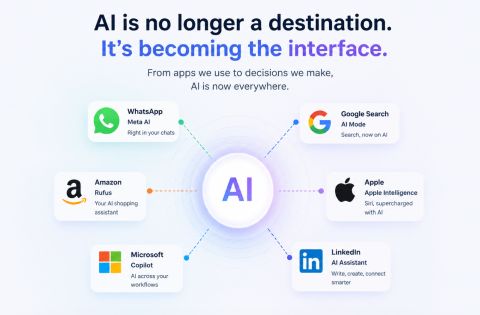
AI was a destination. Today , something fundamentally different is happening — AI is becoming a button.
Open WhatsApp .. Meta AI is waiting for you.
Open Google Search .. AI Mode is one click away.
Open Amazon .. Rufus is ready to answer questions.
Open your iPhone .. Apple Intelligence quietly sits in the background.
Open Microsoft Office .. Copilot is already there.
Notice the pattern?
For the first time in technology history , users are not being asked to discover AI. AI is being inserted into products they already use every day.
Historically , technology adoption looked like this:
New Technology –> New Product –> New Users
Today , the equation has changed:
Existing Product –> AI Layer –> Existing Users
And that changes everything.
– think about Google Search.
– think about WhatsApp.
– think about Amazon.
– think about Apple.
These platforms don’t need to acquire users. They already have billions. The challenge is no longer adoption .. “It is placement”.
.. and AI is being placed exactly where human attention already exists.
This reminds me of previous technology shifts:
“The internet era wasn’t won solely because search engines existed .. but it was won because search became the front door to the web. The smartphone era wasn’t won because mobile apps existed .. but it was won because smartphones became the front door to digital life.
Now we are witnessing something similar. AI is becoming the front door to information , shopping , productivity and decision-making. This is why I believe we are asking the wrong question. Most of our discussions focus on:
– which model is better?
– GPT or Gemini?
– Claude or Grok?
But history suggests technology winners are rarely decided by capability alone. They are often decided by “quick” distribution.
The biggest advantage of Big Tech may not be that they have AI — many companies have AI. The advantage is that they already own daily habits and AI is quietly being woven into those habits.
In one of my earlier posts , I spoke about AI becoming MAYA = Most Advanced Yet Accessible.
Perhaps this is what that looks like in practice:
– not a separate destination.
– not a separate application.
– not even a separate technology.
Just something that appears exactly when and where you need it.
The future may not belong to the smartest AI.
It may belong to the AI you encounter before you realise you need it.
Until next time , happy thinking !!
Author – Sumit Rajwade, Co-founder: mPrompto