The day AI told me to “take a break”!!
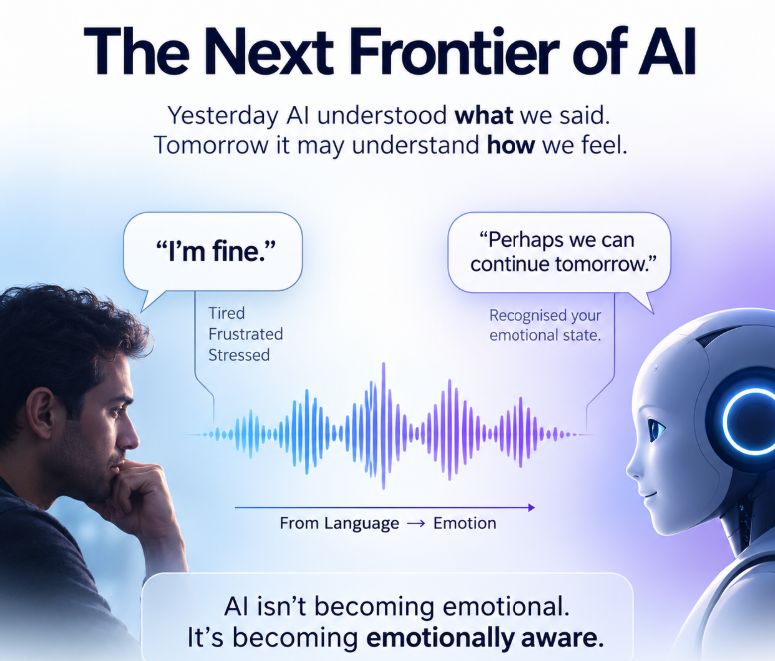
A few weeks ago I was having a voice conversation with ChatGPT. It wasn’t going particularly well. I was tired , speaking faster than usual and my tone had become noticeably irritated. Then something unexpected happened.
I just said in a near-angry tone – “forget it , you are not getting it!”
Instead of answering my next question, it paused and said something along the lines of:
“You sound a little upset. Perhaps we can continue this conversation tomorrow.”
For a moment, I stopped talking – Man!! what just happened?
Not because I believed the AI had feelings but because it had recognised mine and that made me wonder.
For decades computers only understood what we typed. Now they are beginning to infer how we feel while speaking. That’s an entirely different capability. The words remained the same — but the tone had changed .. and the conversation changed with it.
Think about how humans communicate. A simple sentence like: “I’m fine.” can mean something completely different depending on tone. We instinctively recognise frustration , hesitation , excitement or anxiety. These emotional cues have always been invisible to software — Until Now !
Modern AI is no longer limited to text. It can increasingly interpret voice patterns such as pace , pauses , pitch and tone apart from conversational context. That doesn’t mean AI feels emotions .. it can become remarkably good at recognising them.
— This distinction matters.
I believe we’re witnessing the beginning of a new era.
– the first generation of AI understood information.
– the second understood intent.
– the next may understand emotion , not by experiencing it but by recognising it.
Think blue sky and imagine the possibilities:
– a customer service assistant that senses frustration
– a learning platform that notices a student losing confidence
– a healthcare assistant that detects signs of stress
AI is beginning to respond to human states. Naturally, this raises important questions:
– how much emotional data should AI observe?
– who owns that information?
– where do empathy and privacy intersect?
As AI becomes better at reading us , trust becomes even more important. I don’t believe AI is becoming emotional.
𝗜 𝗯𝗲𝗹𝗶𝗲𝘃𝗲 𝗔𝗜 𝗶𝘀 𝗯𝗲𝗰𝗼𝗺𝗶𝗻𝗴 𝗲𝗺𝗼𝘁𝗶𝗼𝗻𝗮𝗹𝗹𝘆 𝗮𝘄𝗮𝗿𝗲.
One is about feeling .. the other is about understanding.
The first remains uniquely human .. the second may become one of AI’s most valuable abilities.
Perhaps the biggest breakthrough won’t be when AI writes better or codes better. It may be when AI knows when not to continue a conversation.
Because sometimes the most intelligent response isn’t another answer .. it’s recognising the human behind the question.
Until next time .. happy thinking!!
Author – Sumit Rajwade, Co-founder: mPrompto