Moravec’s Paradox — the hardest thing for AI is what a child learns first !!
One of the most interesting concepts I came across recently at an AI conference organised by #inc42 was something called Moravec’s Paradox. It sounds technical but the idea is surprisingly simple.
The things humans find difficult .. are often easy for AI.
And
The things humans find effortless .. are often incredibly difficult for AI.
Think about it. AI can:
– beat world champions at chess
– solve complex mathematical problems
– analyse millions of documents
– write software code
Yet it struggles with things a two-year-old does naturally. Like:
– recognising objects in unfamiliar situations
– understanding social cues
– navigating a crowded room
– knowing when someone is joking
– sensing discomfort in a conversation
This feels backwards right? Shouldn’t reasoning be harder than walking? Shouldn’t calculus be harder than recognising a face?
Evolution explains why.
Humans have spent millions of years developing:
– perception
– movement
– intuition
– social awareness
These capabilities are deeply embedded into our biology. Mathematics , programming and formal reasoning arrived only recently in evolutionary terms. As a result , what feels effortless to us is actually the product of millions of years of optimisation — and that is exactly what AI finds difficult.
This got me thinking about work.
For decades we assumed machines would replace repetitive physical work first and cognitive work later. Instead , AI is challenging that assumption. Today AI can draft reports , analyse contracts and generate presentations. Yet a good teacher , nurse , salesperson , leader or parent still relies heavily on skills that are difficult to encode.
– empathy.
– judgement.
– context.
– trust.
– above all , a human perception.
This is why I increasingly believe the future value of work will not come only from intelligence. It will come from what I call cognitive patterns. The ability to:
– connect unrelated ideas
– sense context
– understand people
– navigate ambiguity
– make decisions under uncertainty
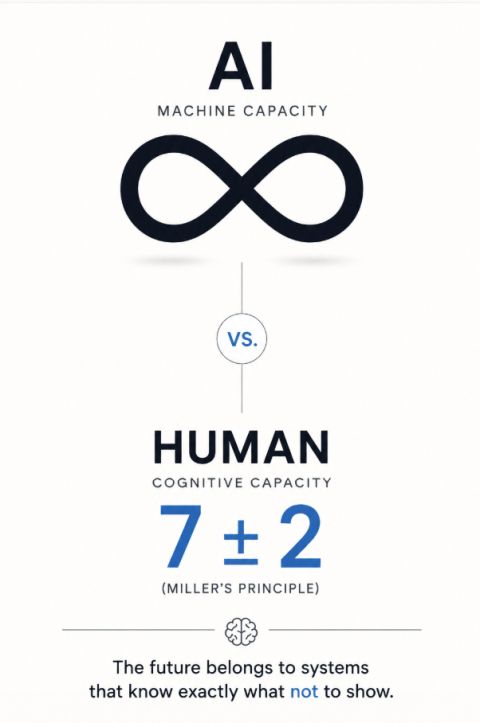
In a world where intelligence becomes abundant , these human capabilities become scarce. And believe me — “scarcity creates value”.
Perhaps the real lesson of Moravec’s Paradox is not about what AI cannot do. It is about helping us recognise what humans have been undervaluing all along.
Because the future may not belong to humans who compete with AI .. It may belong to humans who understand what makes them uniquely human.
Untile next time , happy thinking !!
Author – Sumit Rajwade, Co-founder: mPrompto