AI and the future of customer acquisition , discovery and digital merchandising
Let me start with a claim — the customer will never buy from your website again !!
For nearly three decades, digital commerce has operated on a simple assumption: The customer will eventually visit your website.
Everything in modern digital marketing was built around this belief.
SEO was designed to drive traffic. Paid advertising was designed to acquire traffic. Landing pages were designed to convert traffic. Product pages were designed to persuade traffic. The entire ecosystem revolved around attracting visitors and moving them through a funnel.
But what happens when the customer no longer needs to visit your website to make a decision?
That future may already be arriving.
The rise of AI-referred e-commerce
According to recent findings from Adobe as Forbes article states , shoppers arriving through AI assistants such as ChatGPT and Gemini convert at significantly higher rates than traditional traffic sources. AI-assisted shoppers demonstrate stronger purchase intent , lower bounce rates , higher engagement and larger order values.
Shopify’s own data appears to reinforce this trend showing AI-referred shoppers converting at nearly 50% higher rates than those arriving through traditional organic search.
At first glance, these statistics may seem surprising — they shouldn’t be right?
The reason is simple : AI is compressing the customer journey.. from discovery to decision
Historically, the customer journey looked something like this:
Search –> Compare –> Research –> Evaluate –> Decide –> Buy ??
Most of the effort occurred in the middle.
Customers spent time:
- Reading reviews
- Comparing specifications
- Evaluating alternatives
- Understanding trade-offs
This “consideration layer” became the battleground for marketers.
Today, AI increasingly performs much of that work on behalf of the customer. A user can ask:
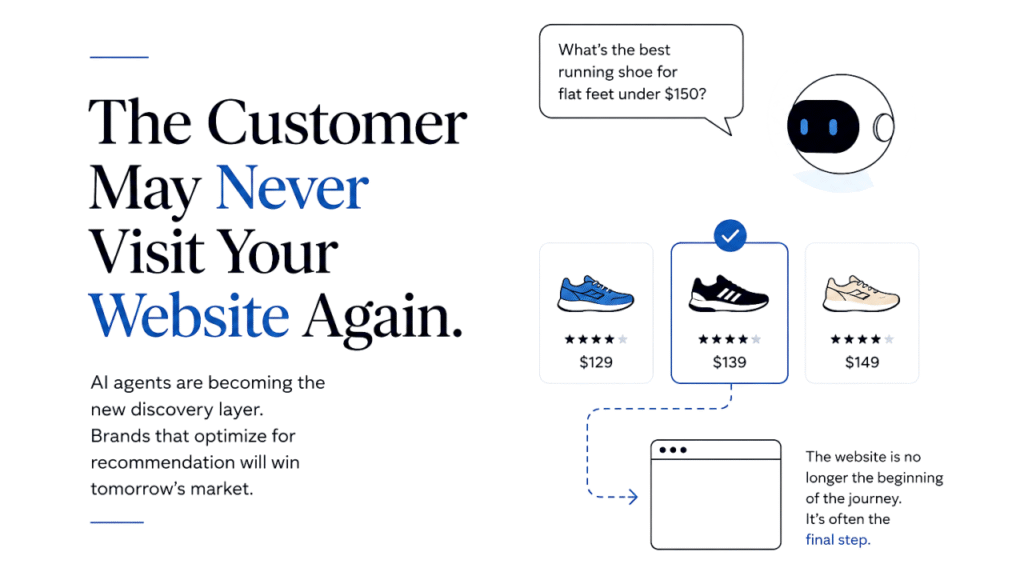
“What’s the best running shoe for someone with flat feet under $150?”
Within seconds , an AI assistant can:
- Understand intent
- Compare alternatives
- Analyse reviews
- Filter options
- Recommend a shortlist
By the time the customer reaches a retailer’s website, much of the decision has already been made. The website is no longer the beginning of the journey. It is often becoming the final step.
For years, brands fought for visibility on:
- Amazon
Tomorrow, they may compete for something entirely different:
Recommendation.
The critical question will no longer be:
“How do I rank?”
Instead it becomes:
“How do I become recommendable?”
That is a fundamentally different challenge.
Because AI systems do not evaluate websites the way humans do.
They evaluate:
- Structured information
- Product specifications
- Reviews
- Policies
- Availability
- Relevance
The future winner may not be the brand with the loudest marketing.
It may be the brand whose information is most understandable to machines.
Death by ranking , of ranking !!
This trend also connects to a broader shift many of us are beginning to observe.
For years, businesses obsessed over ranking:
- Page 1
- Position 3
- Featured snippets
But what happens when an AI assistant recommends only three products?
Or one?
The customer may never see the rest.
In an agent-driven world, ranking becomes less important than recommendation.
Visibility gives way to trust .. search gives way to delegation .. discovery becomes compressed.
Historically, brands designed digital experiences for people.
Tomorrow, they will need to design for both:
- Humans
- AI systems
This means product content can no longer exist solely for persuasion. It must also exist for interpretation. Product descriptions , FAQs , specifications , reviews and support content will increasingly serve two audiences:
- The customer reading it.
- .. and the AI interpreting it.
This may become one of the most important shifts in digital merchandising over the next decade.
SO , THE BIGGER QUESTION?
The biggest impact of AI on commerce may not be better recommendations. It may be something much larger. Brands could gradually lose direct access to customer attention.
Because when an AI assistant becomes the shopper’s trusted advisor, the first conversation no longer happens on your website.
It happens somewhere else.
And the brands that recognise this shift early will not simply optimise for traffic. They will optimise for trust, relevance and recommendation.
Because in the age of AI commerce , the most valuable customer may be the one who never needed to browse in the first place.
Until next time , happy thinking !!
Author – Sumit Rajwade, Co-founder: mPrompto