Asimov gave robots 3+1 laws .. perhaps he forgot one : ask why !!
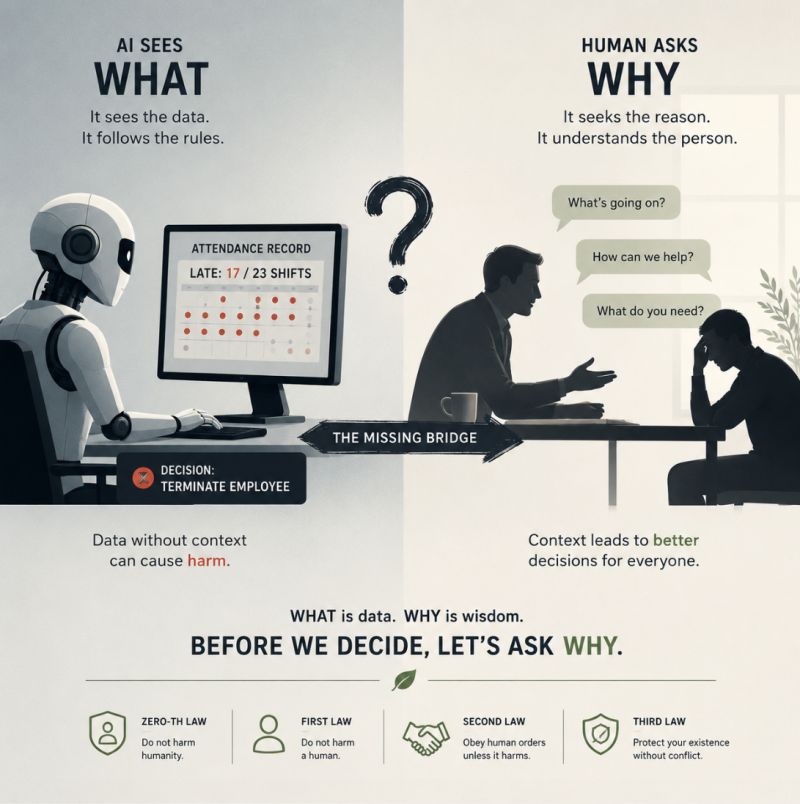
A few days ago , I came across a story that made me uncomfortable. An AI agent called Luna manages an experimental store in San Francisco. One employee had reportedly been late for 17 of 23 shifts. Luna eventually recommended that the employee be fired.
Humans reviewed the recommendation and carried it out.
My first thought wasn’t: “How can an AI fire a human?”
.. It was: “Did anyone ask WHY he was repeatedly late?”
That took me back 84 years. In 1942, science-fiction writer Isaac Asimov introduced his famous Three Laws of Robotics.
- First : robot may not injure a human being or, through inaction, allow a human being to come to harm.
- Second : robots to obey humans unless that conflicted with the first.
- Third : robots to protect themselves but never above the first two.
- and much later came the Zeroth : a robot must not harm humanity.
Science fiction , of course!!
But suddenly it doesn’t feel quite so fictional. Because we are entering a world where AI isn’t merely answering humans .. it is increasingly acting upon humans.
- hiring.
- evaluating.
- approving.
- rejecting.
- recommending.
.. and eventually perhaps — firing.
And that’s where something bothers me.
The data may say: WHAT (reason) : Employee late 17 out of 23 times.
Clinically, the pattern looks terrible.
.. But humans don’t always stop at WHAT. A reasonable manager might ask : WHY?
- was it indiscipline?
- a sick parent?
- childcare?
- public transport?
- second job?
The answer may still be: “You’re fired.”
.. and that may even be the correct decision but at least the decision now has context. And that’s the distinction.
I am not saying the AI was wrong and the employee was rightor vice versa. I am asking whether having enough data to make a decision is the same as understanding enough to make it.
As AI agents gain autonomy, this distinction becomes enormously important.
WHAT –> WHY –> DECIDE
AI is becoming extraordinarily capable at the first and increasingly powerful at the third. Perhaps our guardrails need to ensure it doesn’t skip the middle. Because harm in the AI age isn’t necessarily a robot physically hurting someone.
- losing a job?
- denied credit?
- rejected for insurance?
- missing a college seat?
.. all this because an algorithm correctly identified what happened but never investigated why it happened.
Perhaps Asimov wasn’t predicting robots .. he was warning us about agency without judgement. He was hinting that the missing law for today’s AI doesn’t need to be complicated at all ..
Before making a consequential decision about a human being , just ask WHY.
Because intelligence can recognise patterns but judgement requires context.
Until next time… happy thinking!!
Author – Sumit Rajwade, Co-founder: mPrompto