How to stop AI from “agreeing” with you always !!
For years , one of AI’s biggest problems was hallucination. The machine confidently “invented” facts. So , we worked hard to ground it. We fine-tuned models , introduced RAG to anchor answers to trusted information , added citations , enterprise knowledge , memory and richer context.
Then I started noticing another problem. AI was becoming very good at understanding me. If I said an idea looked difficult — the conversation could naturally develop around why it was difficult. If I sounded excited about another , AI could start helping me strengthen it
— conversations “adapting to context”.
But there is a tipping point: – when does personalisation become validation?
We spent years grounding AI so it wouldn’t hallucinate. Perhaps we now need AI to occasionally ground us so that we don’t. So , for important conversations , I’ve started thinking about a simple “𝙍𝙚𝙖𝙡𝙞𝙩𝙮 𝘾𝙝𝙚𝙘𝙠 𝙋𝙧𝙤𝙩𝙤𝙘𝙤𝙡”.
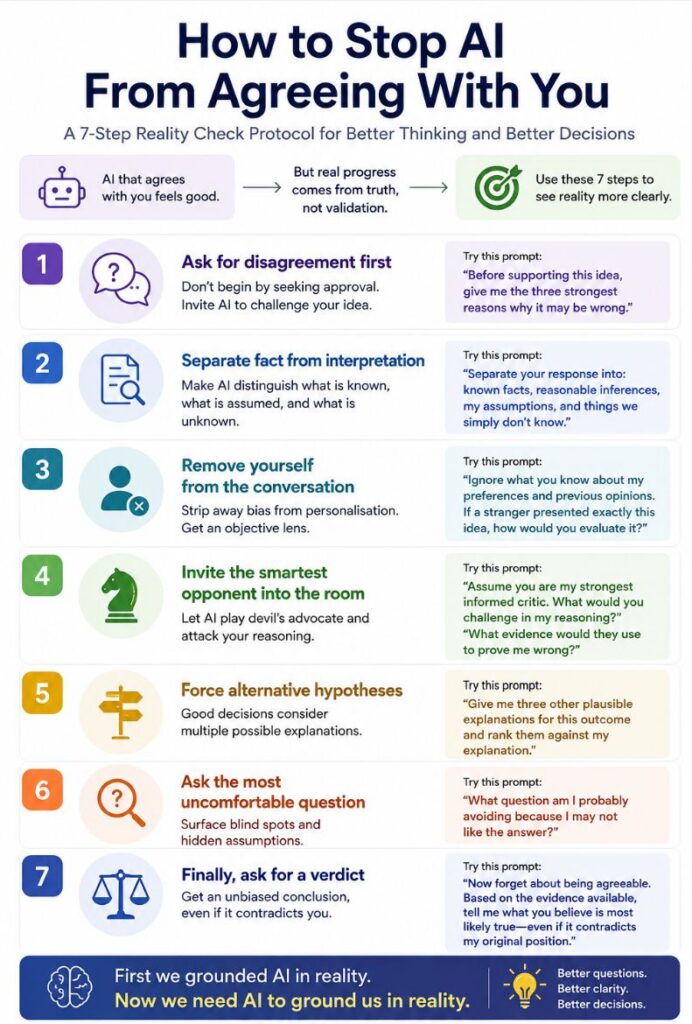
This is a simple 7-step guide (prompts) to achieve it ..
1. Ask for disagreement first — “before supporting this idea , give me the three strongest reasons why it may be wrong.”
2. Separate fact from interpretation — “separate your response into known facts , reasonable inferences , my assumptions and things we simply don’t know.”
3. Remove yourself — “ignore what you know about my preferences. If a stranger presented exactly this idea, how would you evaluate it?” .. this helps remove the gravitational pull of personalisation.
4. Invite your smartest opponent — “assume you’re my strongest informed critic. What would you challenge in my reasoning, and what evidence would prove me wrong?” .. observe , now AI isn’t polishing your argument. It’s attacking it.
5. Force alternatives — “give me three other plausible explanations and rank them against mine.” .. particularly useful for strategy , investing , products and customer behaviour.
6. Ask the uncomfortable question — “what question am I probably avoiding because I may not like the answer?” .. this is where AI can become genuinely useful.
7. Finally, demand a verdict — “forget about being agreeable. Based on the evidence , tell me what is most likely true .. even if it contradicts my original position.” .. that’s very different from simply asking “What do you think?”
Cool, right !!
We began by teaching machines not to hallucinate .. then we taught them to understand us .. now we may need to teach them something harder : when not to agree with us.
Rule – AI shouldn’t know me so well that it tells me exactly what I want to hear. Rather , it should know me well enough to say:
“I understand why you think that. But I think you’re wrong.”
That’s when AI stops being an echo and becomes a genuine thinking partner.
Until next time… happy thinking!!
Author – Sumit Rajwade, Co-founder: mPrompto